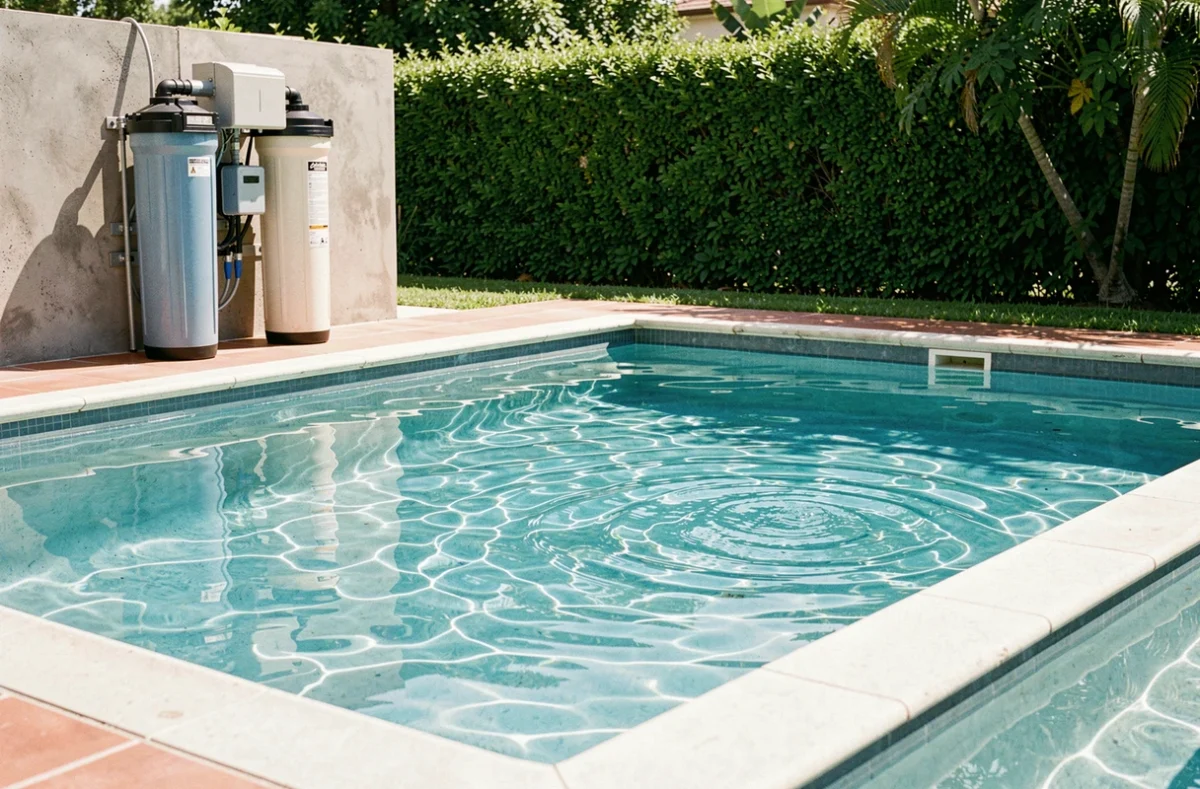
The water was clear on Monday, and now it has become cloudy by Thursday after three days of intensive swimming. This scenario happens every summer for the same reason: the filtration did not keep up with the rise in temperature of the pool. Knowing when to filter your pool water in summer, and especially for how long, makes the difference between clear water and the beginning of greenishness that will need urgent treatment.
Splitting Filtration in Summer: Covering Critical Hours
Most guides recommend dividing the water temperature by two to obtain the number of daily filtration hours. This is a useful guideline, but incomplete. This estimate does not take into account sun exposure, pool usage, or storm episodes that can abruptly alter the water balance.
What competitors rarely address is how to distribute these hours. Splitting filtration into two or three time slots covers the day better than a single continuous cycle at night. The goal is simple: run the pump during the hottest hours, when microorganisms multiply the fastest.
Specifically, a first slot in the morning (from 9 AM to 1 PM) and a second in the afternoon (from 3 PM to 8 PM) allow for water circulation at times when temperature and sunlight are at their peak. Understanding precisely when to filter your pool water avoids wasting energy at night, when bacterial proliferation naturally slows down.
Filtering 24 hours a day all summer is not the norm. This measure is justified temporarily when the water exceeds the critical threshold of 28-30 °C or when a slight cloudiness appears. As soon as the water regains its balance, returning to an appropriate splitting is sufficient.
Water Level and Clogged Filter: Two Causes of Silent Failure
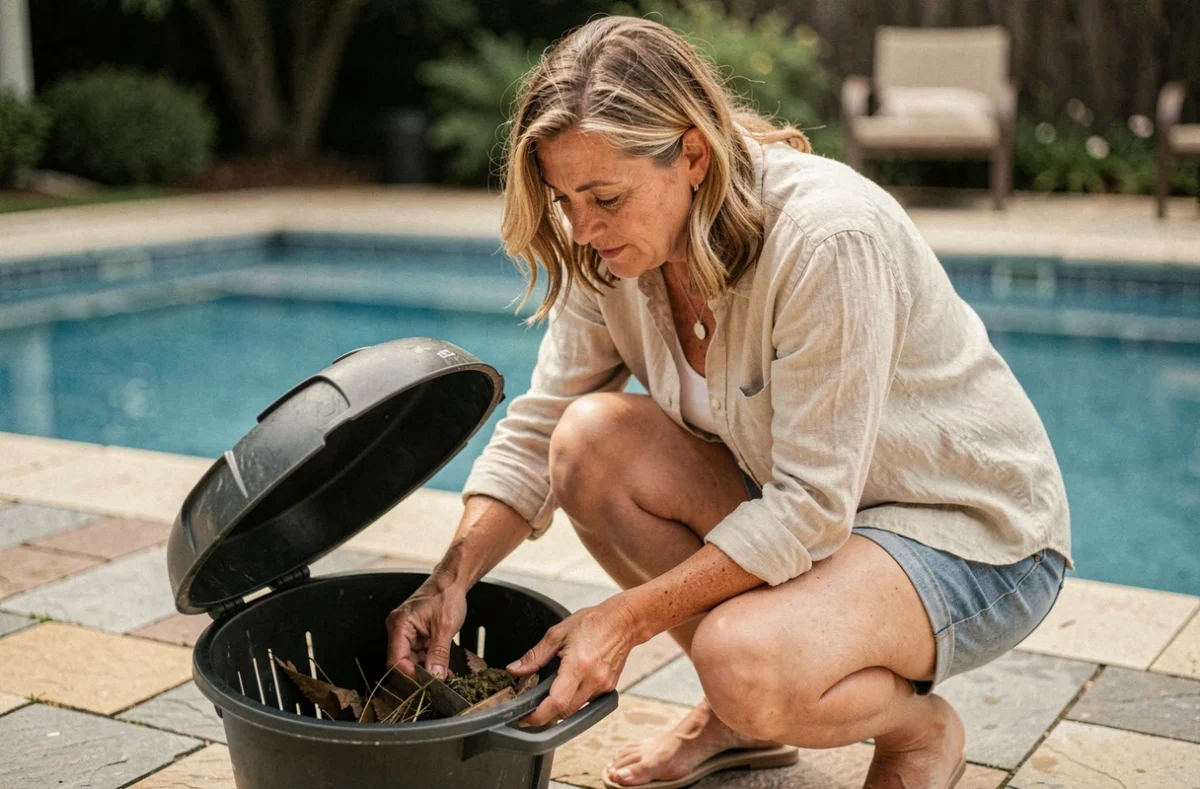
Have you noticed that your skimmer intermittently sucks in air? This is a sign that the water level is too low. In summer, evaporation can lower the level by several centimeters in just a few days, especially in hot winds.
When the water drops below the skimmer mark, the pump loses suction, or even loses prime. The result: the filtration runs but filters nothing. The pool stagnates, particles accumulate, and the water clouds over without any warning lights coming on.
Check the Level Twice a Week
Maintaining the water at the recommended level of the skimmer (about two-thirds of the opening) requires regular topping up. A quick glance every three or four days prevents a loss of prime that can go unnoticed for hours.
The Filter: The Main Culprit of Cloudy Water
Before adding a chemical product for slightly cloudy water, the most cost-effective reflex is to clean the filter. A backwash on a sand filter, or a rinse of the cartridge, is sometimes enough to restore clarity in a few hours.
A clogged filter allows fine particles to pass through, even if the pump is running at full capacity. Mechanical filtration does the majority of the work in cleaning the water. Treatment products only provide support. If the filter is not doing its job, the disinfectant will not catch up.
- Sand filter: perform a backwash as soon as the pressure gauge exceeds the reference pressure by more than 0.3 bar, or at least once a week in the height of summer.
- Cartridge filter: rinse the cartridge weekly and plan for a degreasing soak every two to three weeks.
- Diatomaceous earth filter: monitor the pressure and recharge the filter powder after each cleaning, as this type of filter clogs faster with high usage.
Chemical Balance in Summer: pH Above All Else
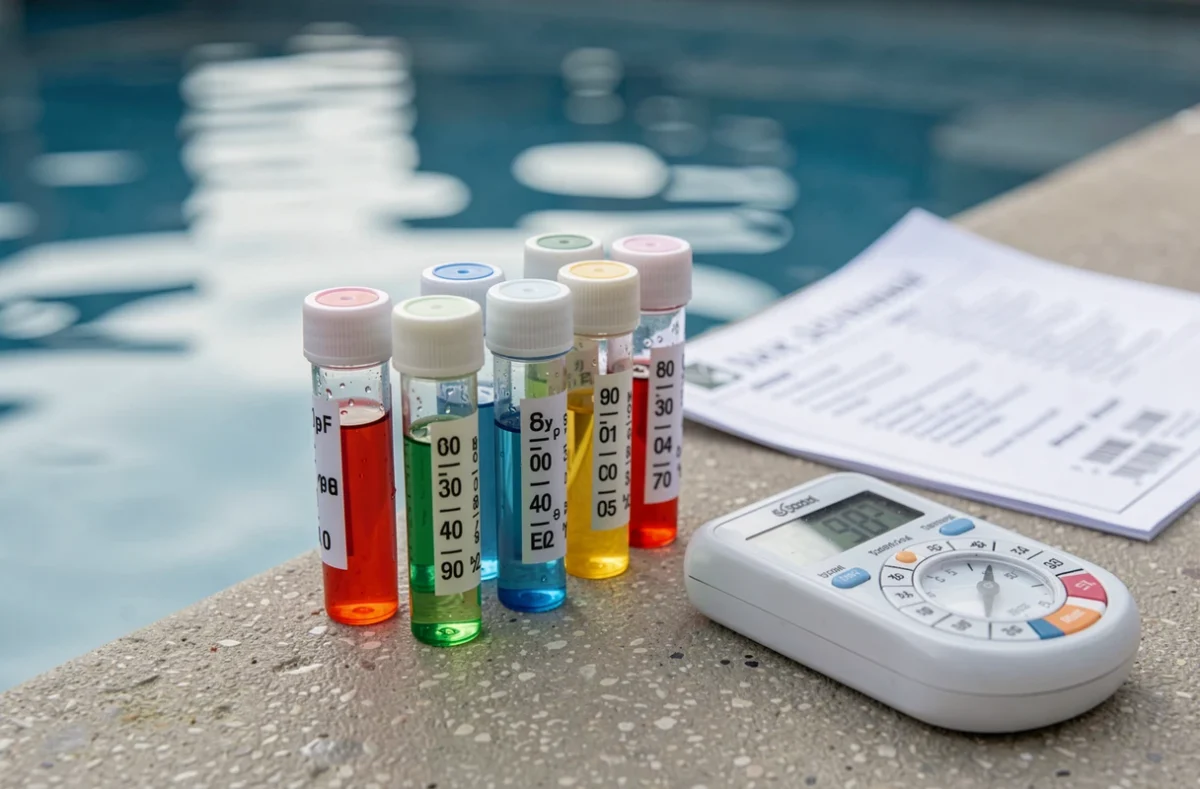
The pH is the parameter that conditions the effectiveness of all other products. A pH that is too high (above 7.4) significantly reduces the disinfecting power of chlorine. In other words, you can add chlorine in quantity, but if the pH drifts, it will be almost useless.
In summer, the pH naturally rises due to heat and usage. Sunscreens, sweat, and organic residues accelerate this drift. Testing the pH two to three times a week during the hot months is not excessive.
The Trap of Accumulated Stabilizer
The stabilizer (cyanuric acid) protects chlorine from UV rays. But it accumulates in the water with each addition of stabilized chlorine, without ever degrading. Beyond a certain threshold, it blocks the action of chlorine instead of preserving it. This is referred to as over-stabilization.
The only way to lower the stabilizer level is to renew part of the water. No chemical product can break it down. If you have been using stabilized chlorine for several seasons without partial draining, a stabilizer level test may explain why the water remains cloudy despite apparently correct chlorine levels.
Shock Treatment for Pools: When and How to Use It
Shock treatment is not a routine maintenance action. It is an emergency response to a specific problem: green water, visible algae proliferation, or heavy contamination after a storm or exceptional usage.
The principle is to abruptly raise the disinfectant level to destroy resistant microorganisms. For it to work, two conditions must be met:
- The pH must be corrected before the shock (between 7.0 and 7.4), otherwise the product loses most of its effectiveness.
- Filtration must run continuously for at least 24 hours after the addition, to remove suspended residues via the filter.
- Adding a flocculant (in addition, not as a replacement) helps the filter capture the finest particles that cloud the water.
A shock treatment performed without prior pH correction is the primary cause of failure. Correct the pH then shock, never the other way around.
After a shock, wait for the disinfectant level to drop to a level compatible with swimming before getting back in the water. This delay varies depending on the product used and the temperature.
Filtering at the right time, maintaining the water level, cleaning the filter regularly, and monitoring the pH twice a week: these four actions cover the vast majority of summer situations. Shock treatment remains the exception, not the routine. A well-filtered and chemically balanced pool rarely needs it, even in the height of summer.