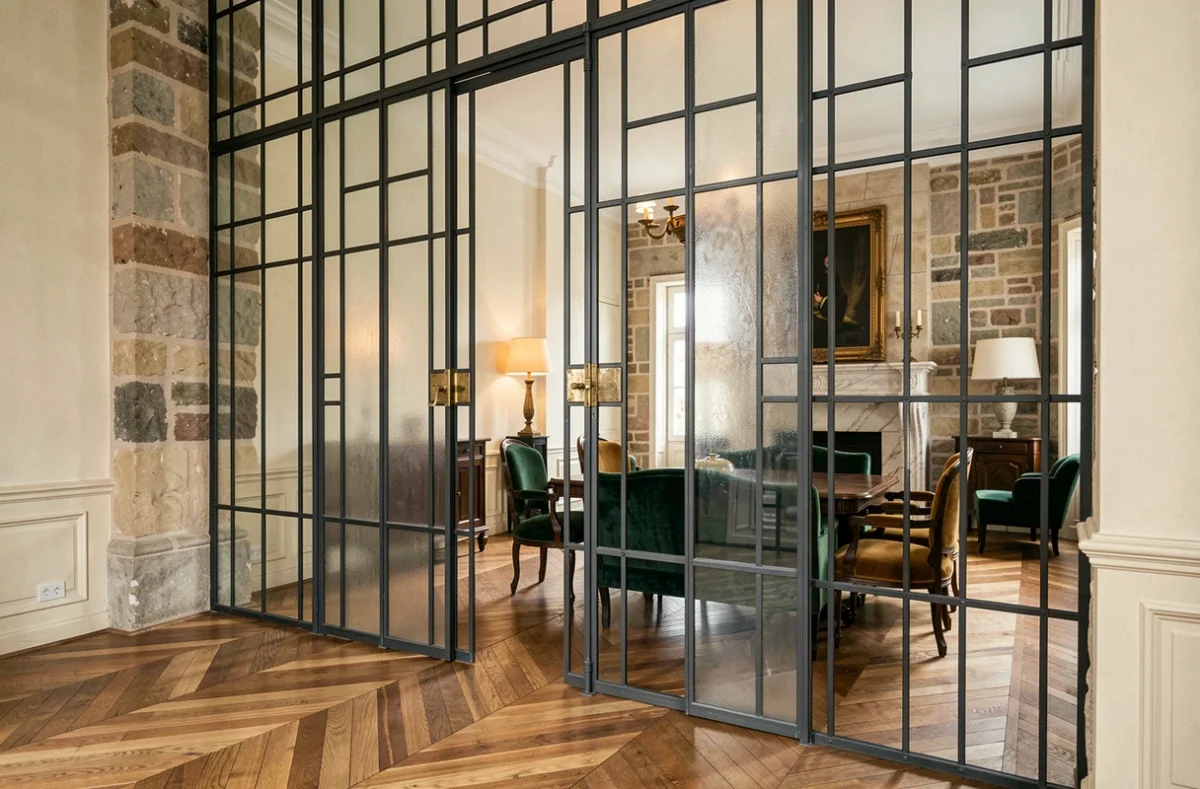
The Art Deco glass wall stands out from the classic workshop glass wall by its graphic vocabulary: asymmetrical crossbars, offset rectangles, and stylized curves replace the regular grid of industrial models. This ornamental geometry, inherited from the decorative arts movement that emerged in the 1920s, transforms a simple glass partition into a fully-fledged visual composition element.
Fluted glass and slim frames: what’s changing in interior glass walls
The black glass wall with wide metal frames remains a classic, but the current trend leans towards more discreet profiles. Slim frames, often made of aluminum, lighten the structure and allow for more glass space.
The choice of glass directs the overall result. Fluted or textured glass filters views without blocking light, a particularly useful compromise between kitchen and living room or facing a bathroom. Frosted or slightly tinted glass produces a comparable effect, with a more homogeneous light diffusion.
In terms of colors, recent interiors are moving away from systematic black. Off-white, beige, brown, and deep green allow for coordination of the glass wall with the surrounding walls. This soft palette fits well with the Art Deco vocabulary, which favors polished surfaces and bold colors rather than industrial rawness. To explore other graphic combinations, several decor inspirations on La Petite Maison dans la Prairie show how to combine geometric shapes and contemporary finishes.
Creating an Art Deco glass wall: geometry, materials, and proportions
The Art Deco style is based on decorative geometry, not structural. The crossbars do not follow a regular rhythm: they create rectangles of varying sizes, sometimes complemented by an arch or a fan pattern. This composition, often referred to as the Mondrian style in the jargon of manufacturers, requires preliminary drawing work.
Three materials, three finishes
- Aluminum: lightweight, thin, compatible with various shades (RAL black, white, anthracite gray, custom colors). It is suitable for graphic compositions where the frames need to remain discreet.
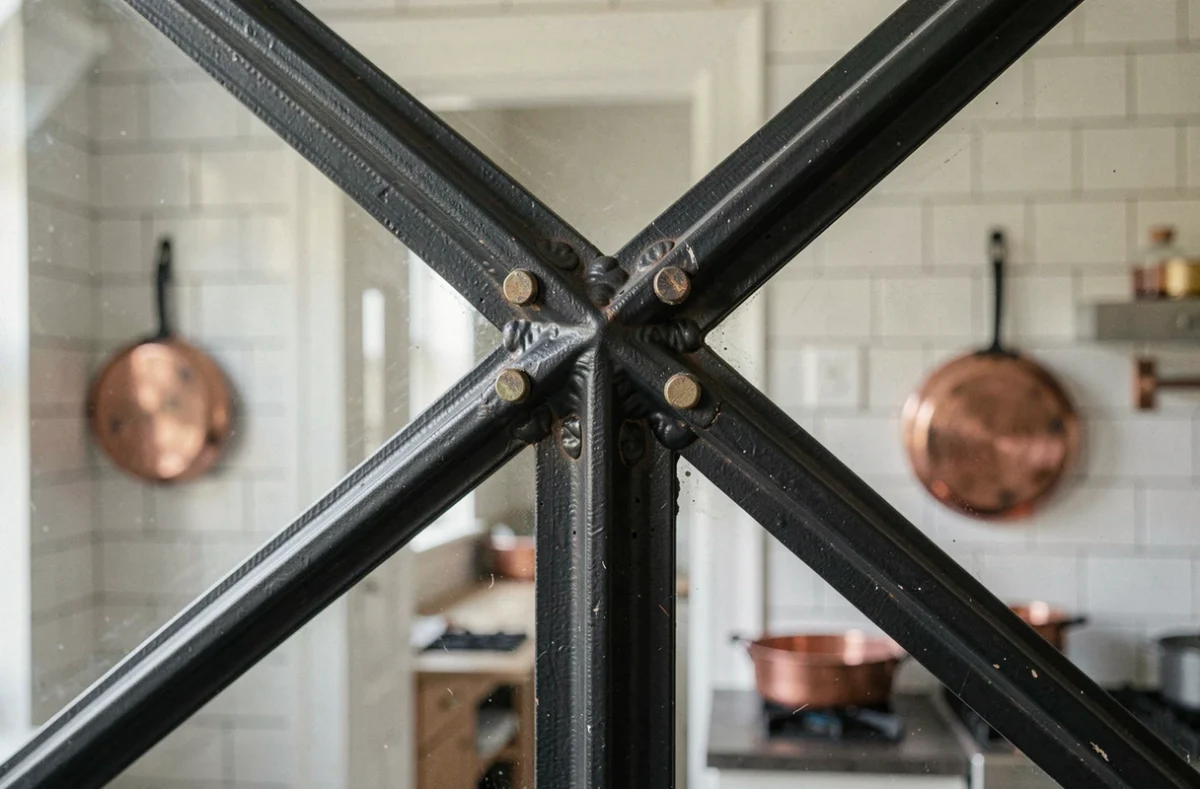
- Steel: more massive, it reinforces the “visible structure” aspect and is suitable for interiors that embrace a raw side tempered by Art Deco design.
- Solid wood: it adds warmth and can be painted or varnished to integrate into a more subdued decor. Wood pairs well with the rounded shapes characteristic of the movement.
The choice of material also determines the thickness of the profiles. An aluminum frame of a few centimeters allows significantly more light than a steel profile twice as wide. In a narrow hallway or a poorly lit room, this difference is felt daily.
Proportions and placement
An Art Deco glass wall gains impact when it occupies a generous surface, from floor to ceiling or across the entire width of an opening. Small formats (transom above a door, for example) also work, provided that the design of the crossbars remains legible.
The composition must take into account the symmetry of the room. An offset load-bearing wall or a sloped ceiling alters the reading of the rectangles. Drawing the pattern to scale before ordering avoids visible imbalances once the glass wall is installed.

Acoustic insulation of an interior glass wall: a often underestimated point
An interior glass wall does not, by itself, provide a sound insulation solution. Acoustic performance depends on the entire frame-glazing assembly, the sealing of peripheral joints, and the thickness of the glass.
Single glazing allows most conversations and kitchen noises to pass through. To mitigate disturbances, an asymmetrical acoustic double glazing (two different glass thicknesses) proves more effective than standard triple glazing. Acoustic laminated glass, made of soft interlayer layers, complements the system.
The sealing of the frame is as important as the glazing. A poorly installed peripheral seal or misaligned profile creates a sound bridge that nullifies the effect of the glass. If the glass wall separates a sleeping area from a living room, this detail deserves special attention during installation.
Art Deco glass wall in the kitchen or living room: adapting the style to the room
Between the kitchen and living room, the Art Deco glass wall serves a dual purpose: it partitions without closing off and filters cooking odors when paired with a glass sliding door. Fluted glass makes perfect sense here, as it conceals the clutter of the countertop while maintaining light continuity.
In a living room, a glass wall as a partition can delineate an office or reading nook. The Art Deco geometric shapes then provide a decorative element that stands on its own, without needing a painting or wall shelf on the concerned wall.
- Open kitchen: prioritize easy-to-clean glazing (smooth glass on the cooking side) and frames resistant to grease splashes.
- Living room-office: choose partially frosted glazing if visual privacy matters, or transparent if light is a priority.
- Entryway or hallway: a fixed glass wall with a pronounced Art Deco pattern creates a focal point right at the entrance of the house.
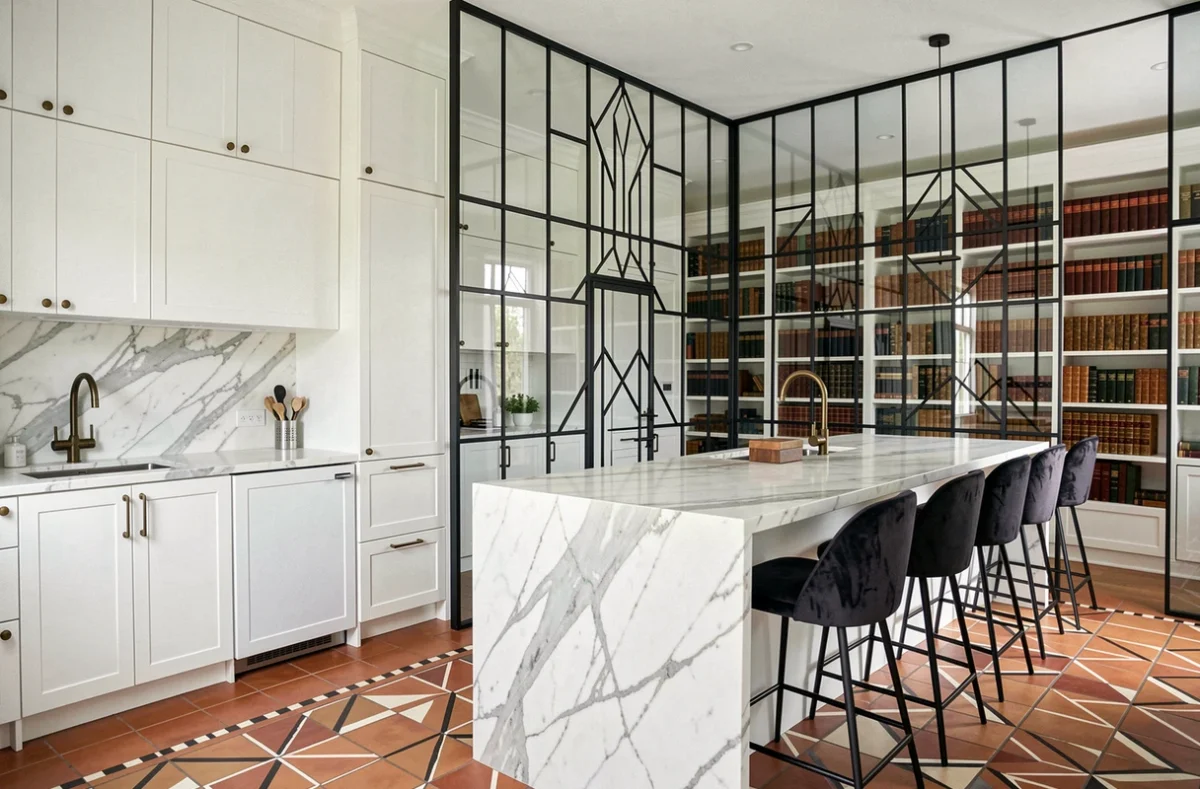
The Art Deco style is characterized by noble materials with meticulous finishes. Coordinating handles, switches, and light fixtures with the shades of the glass wall enhances the coherence of the decor without overcrowding the space. Brushed brass or polished chrome, reminiscent of the reflective surfaces typical of the movement, is enough to anchor the whole in a clearly defined Art Deco reading.
The glass wall remains a custom element whose dimensions, design, and glazing depend on each configuration. Checking acoustic sealing, choosing glass suitable for the room’s use, and drawing the composition to scale before fabrication are the three points that separate a successful project from a disappointing installation.